How to 10X the Productivity of Your Shop Labor
Richard Burroughs IV, CEO, EVOLVE

Conduit bending, including surrounding fabrication tasks like cutting, is one of the largest contributors to direct labor costs in an electrical shop. Recently, I sat down with Eric Opstehdal from Briggs Electric to examine the impact that adopting CNC bending has had on his operation and how contractors who adopt the technology can increase the productivity of their labor costs by ten times.
What we found was that contractors who adopt automated CNC bending dramatically increase throughput, regardless of the size of their operation. We also found that this higher productivity at the bending station shifts constraints to finishing, quality control (QC), and assembly. To understand the full impact of CNC bending on labor productivity, it’s helpful to examine it from three perspectives:
Impact on direct labor costs per bend
Impact on overall conduit output
Bottleneck resolution and system constraint lift
How CNC Bending Reduces Direct Labor Costs Per Bend
Compared to traditional bending, CNC technology dramatically reduces the direct labor cost per bend. The greatest gains occur on larger and more complex bends, especially 3” and 4” compound bends. Similar improvements can be realized across virtually every conduit size, bend type, and material, meaning that shops of every size can benefit.
A traditional hydraulic bending work cell typically consists of one journeyman and one apprentice. Over an eight-hour shift, that team can produce approximately 30 large compound bends. This figure includes every step in the process: loading, marking, bending, validation, and other pre- and post-fabrication activities. The result is a 15-minute cycle time, or 30 minutes of total direct labor, since two people are required for this process.
A CNC bender like a CRIPPA machine, on the other hand, can be operated by a single worker, immediately reducing labor requirements by half. Actual machine bending time drops to roughly 45-70 seconds per bend. Barcode-driven automation instantly loads bend instructions into the machine, eliminating manual layout and bend marking, while improved precision increases first-pass yield to approximately 98%. As a result, QC shifts from finding and correcting errors to confirming accuracy.
When all supporting activities are included, total direct labor per bend falls from 30 minutes to only five—an 83% reduction.
This analysis assumes an apprentice is the one operating the CNC bender. Under the more conservative assumption that a journeyman is operating the bender, reducing the work cell from two people to one still lowers the labor cost per minute by ~40%.
When the lower labor rate is combined with the 83% reduction in labor time, the result is an approximately 90% lower direct labor cost per bend. Put another way, every labor dollar invested in conduit bending becomes roughly ten times more productive.
Customer Success Story: How Brandt Improved Conduit Fabrication with EVOLVE.
Learn how Brandt uses EVOLVE to connect Revit directly to conduit fabrication, giving its shop the accurate, fabrication-ready information needed to produce bends faster and with greater confidence.
How CNC Bending Increases Overall Output
Along with accomplishing these savings in direct labor costs, CNC bending significantly boosts overall shop output. Holding all other factors constant, decreasing cycle time from 15 minutes to five represents a 3-4X gain in overall output.
Looking at production from a broader perspective, a CNC bending work cell can produce between 140 and 240 bends per day, depending mainly on bend complexity and the number of tooling changes required. At the lower end of that range, output assumes approximately one hour of downtime for tooling changes throughout the shift. When producing simpler bends, such as standard 90s, with few or no tooling changes, daily output can increase to as many as 240 bends. This ability to produce significantly more work across all bend types without adding labor is one of the primary economic advantages of CNC bending.
Leading shops like Briggs eliminate downtime and process complexity by producing bends 1-2 weeks ahead of schedule, giving them the flexibility to optimize batch size by conduit diameter.
The combination of a 3-4X increase in output and significantly lower labor costs eliminates bending as the primary production constraint. As capacity increases, the bottleneck moves, allowing contractors to spread labor to the next limiting process and increase throughput across the entire fabrication process.
CNC Bending – Lift System Constraint
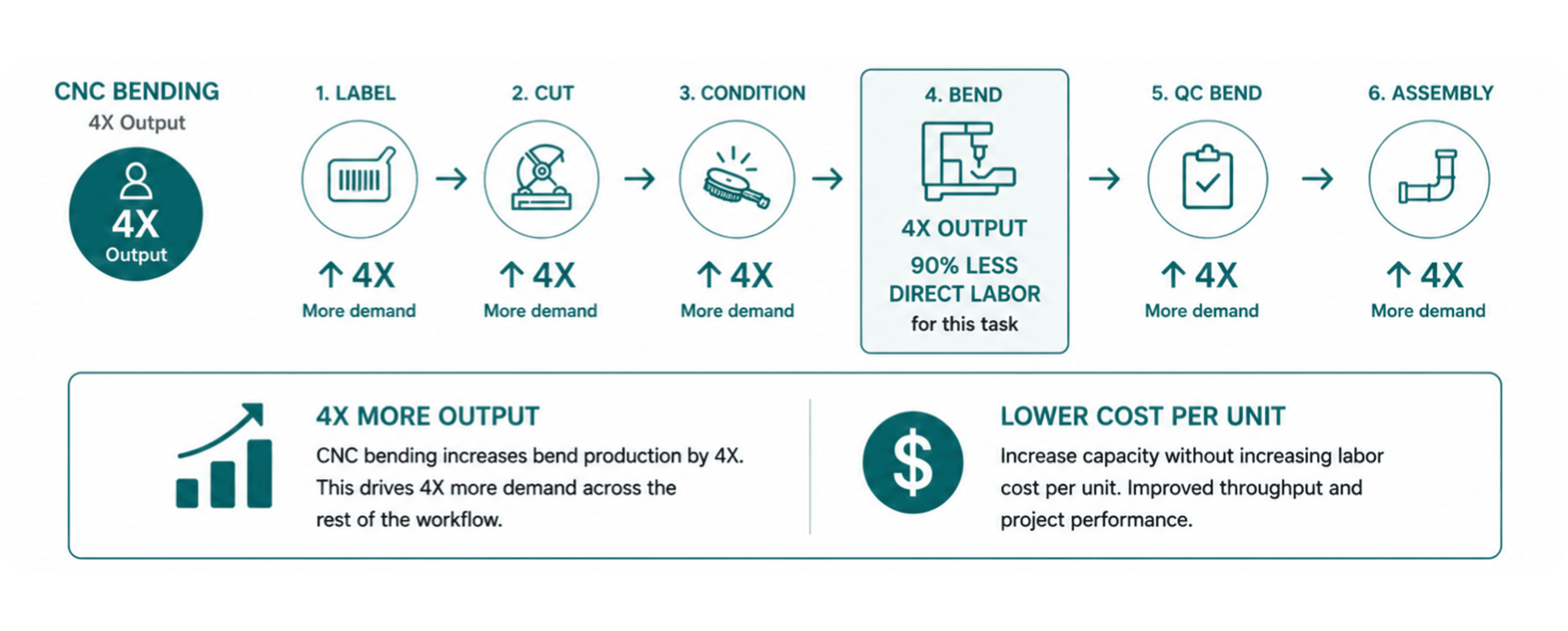
CNC Bending Allows you to Lift System Constraint
When a bend can be produced in ~60 seconds on average and the need for bend marking is eliminated entirely, the demand for labelling, cutting, QC, and downstream tasks such as assembly and packing goes up significantly. Because of this, leading contractors take the direct labor savings on bending and increase their labor spend on these surrounding tasks.
For example, Eric’s production team at Briggs Electric consists of six people:
Two laborers dedicated to material preparation, finishing, and packaging
One CNC machine operator
One to two QC specialists, depending on bend complexity
One journeyman serving as team lead
This staffing arrangement keeps the CNC machine operating continuously while preventing work-in-process inventory from accumulating downstream.
In this model, a single journeyman oversees a team of junior personnel supporting the production process. This keeps the CNC bender operating at maximum uptime while ensuring its 3-4X increase in output is realized across the entire bend fabrication workflow. Rather than creating bottlenecks downstream, labor is aligned to keep work moving, increasing overall throughput for the entire shop.
Customer Success Story: How Rex Moore Scaled Their Prefabrication Process with EVOLVE
Discover how Rex Moore uses EVOLVE to improve prefabrication workflows, increase production capacity, and support more efficient electrical construction.
When Technology, Process, and Labor Work Together
The real magic from CNC bending occurs when technology, process, and labor strategy work together. Software and automation dramatically reduce cycle times at every step, from design through assembly, while labor is organized to keep the machine operating at maximum uptime to support significantly increased production.
For contractors facing increasing labor costs and growing project demands, this represents a fundamentally different approach to fabrication. Instead of adding people to produce more bends, shops can use automation to multiply the productivity of the workforce they already have, making every labor dollar invested in conduit bending ten times more valuable.
Enjoy this post? Check out our recent article: ROI of Crippa CNC Bending with EVOLVE Fabrication